
What We Do
The Victorian Chicken Growers Council is the peak Growers body for participants in the chicken meat industry in Victoria. The VCGC represents chicken growers and their families in Victoria promoting their best interests.
The VCGC was formed in October 2021 to solely focus on the Victorian Chicken Meat industry and the welfare of growers as a Cooperative ‘owned by growers for growers’ and it a state member of the Australian Chicken Council (ACGC). The ACGC represents the chicken meat growers of Australia on the Australian Chicken Meat Federation (ACMF) who produce 90% of Australia’s chicken meat.
The main aim of the VCGC is to promote and represent the interests of the chicken meat industry of Victoria.
The VCGC is represented in the industry at both a national level (via the ACGC) and a state level (via the VCGC) in matters regarding quarantine, animal health, biosecurity, food standards, food safety, animal welfare and a range of other areas affecting the Australian and Victorian chicken industry. It is also actively involved in providing strategic direction to industry relevant research and development bodies, and is a signatory to the Emergency Animal Disease Response Agreement, and a member of Animal Health Australia through the membership of the ACMF.
The VCGC has a key role in policy advocacy and representation of collective bargaining for the chicken meat industry in Victoria., including in areas such as food safety, animal welfare, farming and processing practices, biosecurity, disease prevention and management, and environmental practices through the successful Chicken Care Programme supported by Victorian Processor Companies and Victorian Growers.
Our Industry
The chicken meat industry is a vertically integrated model where individual companies own almost all aspects of chicken production – parent breeding farms, hatcheries, feed mills, processing plants and some chicken broiler farms. This is quite different to how many other rural industries operate.
The two largest integrated chicken companies are the family-owned Baiada Poultry and the publicly-listed Ingham’s Enterprises, and between them they supply approximately 70% of Australia’s meat chickens. Both companies are headquartered in NSW, with chicken production and processing operations throughout Australia’s states. The balance of the market is supplied by another four medium-sized, privately owned integrated companies, which each supply between approximately 3% and 9% of the national market. These companies are located in NSW (Cordina Chicken Farms), Victoria (Turosi Foods and Hazeldene’s) and Queensland (Golden Cockerel). A number of smaller processors make up the remaining 5-9% of production.
Rearing of the meat chickens, from day old chicks to the day of processing, is generally contracted out by the integrated chicken processing companies to contract chicken farmers. Approximately 700 chicken farmers produce about 80% of Australia ’s meat chickens under these contracts. These farms are generally owned by independent family farmers or corporate businesses.
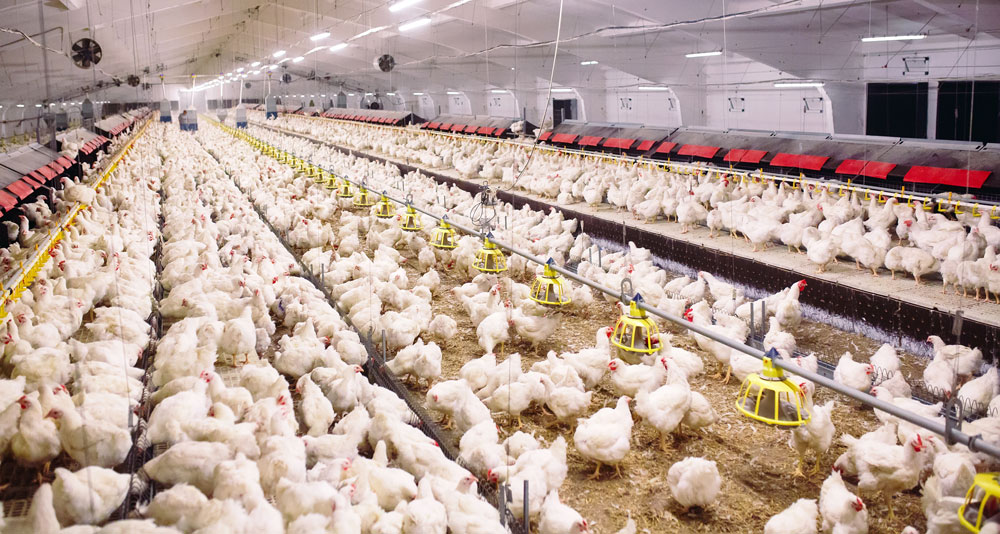
Most commercial meat chicken farms are intensive, highly mechanised operations that occupy relatively small areas compared with other forms of farming. Meat chickens are not kept in cages in any of the production systems used in the Australian chicken industry. The main systems are generally referred to as conventional (barn) and free-range, with a small number of birds raised in organic systems. A conventional farm raises chickens on the floors of large enclosed barns and the birds do not have access to an outside area or range. These farms are the main types used in Australia, but a significant proportion of birds are now raised in free range systems, where in addition to their barn, the chickens are able to access an outdoors area during daylight hours after they are old enough to deal with the outside temperatures and big enough that they aren’t at high risk of predation. Free range meat chickens are produced using similar management and feeding practices as for conventional meat chickens.
Under 1% of birds are raised in organic systems, where the focus is on avoiding the use of synthetic chemicals such as synthetic pesticides, herbicides, fertilisers and antibiotics. Feed must be predominantly from certified organic ingredients and birds cannot be given antibiotics or routine vaccinations.
Many conventional and free range farms raise birds according to the standards of third party accreditation schemes, such as the RSPCA Approved Farming scheme and the Free Range Egg and Poultry Australia (FREPA) certification scheme.